Ongoing Financial Planning
Our investment process begins with a simple principle: portfolios should be built to serve client goals.
Markets evolve, economic conditions change, and life circumstances shift. While outcomes can never be guaranteed, we believe a systematic, research-informed process provides a durable foundation for navigating uncertainty and pursuing long-term financial goals.
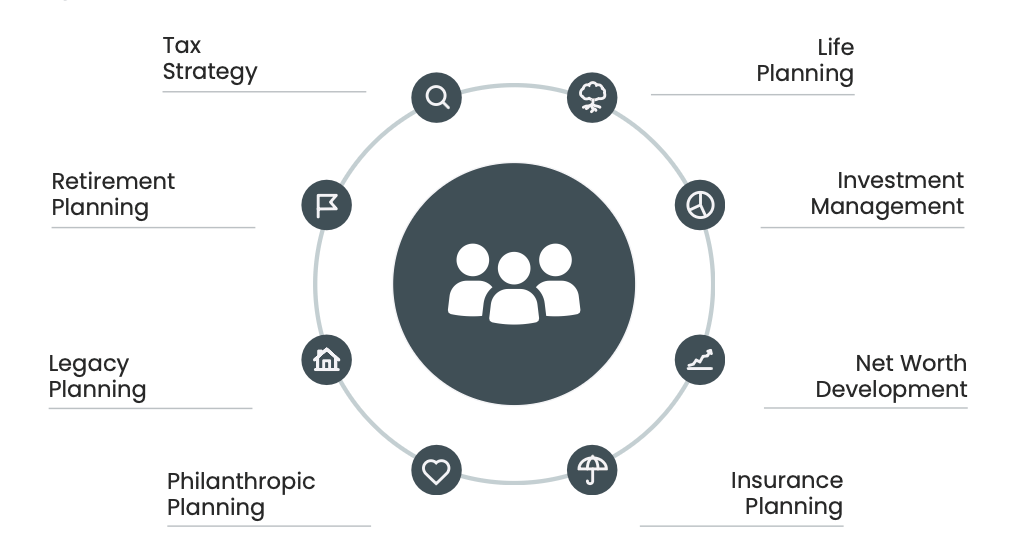
While every client’s situation is unique, the way investment decisions are made follows a consistent, disciplined structure. This systematic process integrates financial planning insights with portfolio construction and ongoing oversight. It is designed to balance growth and risk over time while remaining flexible as client needs and market conditions evolve.
The broad process consists of five steps:
Step One: Understanding your goals and circumstances.
Your goals define the purpose of your portfolio. We begin by developing a clear understanding of your financial objectives, time horizons, assets, account types, and personal priorities. This context informs every aspect of portfolio design and is revisited regularly as life evolves.
Step Two: Risk assessment.
Before recommending a particular portfolio strategy, we help you assess your ability, willingness, and need to take risk as well as your comfort owning a portfolio that will behave differently from the U.S. stock market.
Step Three: Understanding the investment strategy.
We want you to understand the investment philosophy which we will discuss in greater detail in this white paper.
Step Four: Building your portfolio.
Once we have completed the discovery process, helped you assess variousaspects of risk, and explained our approach to investing, we will work together to implement your portfolio. Portfolios are typically composed of U.S., international, and emerging markets stock funds; high-quality bonds held individually or through U.S. Stocks bond funds; and, in some cases,
alternative investment strategies, which we will discuss in more detail.
As part of implementation, we will focus on proper asset location, which is the process of locating tax-inefficient investments in tax-advantaged accounts, like IRAs, Roth IRAs, and 401(k) accounts.
Step Five: Ongoing maintenance.
After the portfolio is implemented, to ensure the portfolio’s asset allocation remains close to the the one agreed upon, periodic balancing will occur. In addition, through periodic meetings we will make sure that we continue to understand all aspects of your life, in particular being sensitive to whether your investment goals and objectives have changed since the original implementation of the portfolio.