Portfolio Review
Fundamentals of Investing
The investment universe is bigger than you might expect, and you have quite a few choices when it comes to putting a financial and investment plan into action. In the end, saving and investing are the fundamental means towards achieving your financial goals—and freeing up your time to focus on the areas of life you value most.
The Foundation of Every Portfolio
Before building a portfolio to help you achieve your plan, you’ll want to understand the choices you have. The basic levers in portfolio design are stocks and bonds. They are the two main investment options available to investors, as well as the primary methods through which public companies raise money to invest in their operations.
When buying shares of a company, you hope to capture a share of their future profits, but when buying bonds you’re counting on being repaid the money loaned, with interest.
Stocks: Also referred to as equities, stocks are considered a purchase of ownership in, and in turn, a share of a company. Since future cash flows and profits are highly uncertain, stocks tend to be a riskier and potentially more lucrative investment option.
Bonds: Also called fixed income, bonds can be considered loans to governments or a company in exchange for interest payments or additional income. Since most bonds have defined cash flows, they tend to be less risky than many other investments.
Portfolio Strategy
Whether you need help growing your wealth or protecting it, a diversified portfolio ensures that each investment has distinct characteristics and will react differently to economic, political, and societal influences. This is one way to use research over guesswork when designing your portfolio.
A Diversifying Approach
While many professionally designed portfolios will use a combination of stocks and bonds, looking beyond traditional asset classes provides a better picture of the underlying risks that drive performance and how to capture them effectively. The goal is to provide true diversification to help improve your investment journey.
Tilt stocks to improve your outcome. Use stocks to grow the portfolio and invest in companies both big and small around the globe. Investing more in companies that share certain characteristics can change the risks of your portfolio, also increasing your potential for higher returns. We call this tilting the portfolio.
Emphasize bonds that offset stock market risk. The main purpose of bonds is to protect the wealth you’ve worked hard to accumulate. This may be achieved by prioritizing secure and creditworthy bonds, like those backed by the U.S. government. Including bonds that will be repaid (or mature) within the next one to 10 years helps insulate the portfolio from the larger price swings that stocks often endure. High-quality bonds can help provide the cushion your portfolio needs to endure through poor stock market performance.
Consider adding alternatives to improve your portfolio. Alternatives are simply investments that have different sets of risk compared to traditional stocks or bonds. Although these strategies may not be suitable for everyone, they can offer another source of risk and return. Adding alternatives can cushion the portfolio from stock market fluctuations while offering a greater chance for growth compared to high-quality bonds. Even a small allocation to alternatives can protect the portfolio from stock market declines.
Managing Your Portfolio
Managing Your Portfolio with Discipline
Some managers prefer to add flair by taking unnecessary risks such as making tactical speculative adjustments based on hunches—not research. Disciplined portfolio management is decidedly different. The process focuses on areas we can control such as rebalancing and tax management. Rather than guessing what investment implications may arise out of short-term news, a rules-based approach results in fewer surprises and potentially better outcomes.
Managing the Emotions of Investing
As you start your investment journey with your advisor, you’ll likely feel excited for the future. As markets oscillate, however, many investors experience emotional cycles. Even the best investment strategy is moot without the discipline and conviction to stay invested through rough market patches. But positive investment outcomes come from marrying a good strategy with predictable behavior. This is done to anticipate some of the inherent emotions—from excitement to fear to relief—coming from market cycles that can otherwise affect better decisions.
Preparing for the Rough Patches
A good start to the investment journey may involve establishing an Investment Policy Statement that will guide how to respond to different market environments. Because, as history shows us, market declines are not uncommon. Despite the frequency of market hiccups, a long- term perspective highlights the potential benefit of staying invested. Plan for market declines, because on average:
- One in every three months, stock markets lose value.
- Stock markets will decline by 10% or more once every two years.
- Stock markets will decline by 20% or more once every four years.
Keeping Your Portfolio in Balance—So You Can Focus on What Matters
Markets move every day—that’s expected. Your advisor will monitor your portfolio to help ensure it stays in line with your tolerance for risk. As your portfolio moves out of balance, your portfolio management team should sell some of what’s done well and buy some of what’s done poorly. This is called rebalancing, and it enforces a discipline of buying
low and selling high.
Turning Losses into Tax Breaks
Sometimes investments go down in value. In fact, some may be worth less than what you bought them for. Yet, these can be used to help offset gains and better manage taxes. This is known as tax-loss harvesting and the benefits are key to an ongoing strategy that includes:
- Identifying and replacing assets that have gone down in value
- Locking in losses to offset taxable gains
- Keeping the portfolio in line with target allocation
- Reducing overall tax burden
Changing Your Portfolio as Your Life Changes
Life isn’t linear. That’s why a research-driven approach combines monitoring your portfolio with reviewing your plan and financial goals. Based on your circumstances, the likelihood you will be able to meet and exceed your goals may change. As a result, your advisor may recommend adjustments, such as saving and spending changes, to maintain a healthy probability of future success.
Investing Strategies Are Continually Evolving
Our collaborative investment strategy combines strong convictions and a passion to progress. An investment committee, in conjunction with your advisor, scours academic and other research in pursuit of better outcomes for clients. Recommendations are not based on the opinion of your advisor or any individual within their network. Rather, the recommendations are based on decades of academic and practitioner research and as the evidence evolves, so should the recommendations. Relying on research to guide investment decisions might slow down the implementation of new strategies. But that is OK. Your financial well- being deserves a careful, thoughtful approach.
How Your Advisor Can Add Value
The value of working with a professional team extends well beyond the returns you earn on your investments. According to a Vanguard study, professional support across implementation, rebalancing, behavioral coaching, tax management, and spending strategies has the potential to add about 3% in total net returns each year!
Typical Value Added for Client
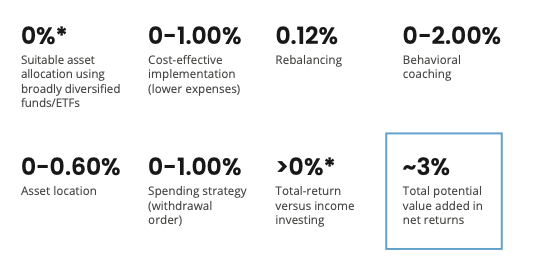
*Value is significant but too unique to each investor to quantify.
Source: Celebrating Vanguard Advisor’s Alpha: Clients and their advisors thriving together for 25 years.
Breaking Down the Indexes
When you see the financial news, they are typically reporting on the Dow Jones Industrial Average (DJIA), the S&P 500, or the NASDAQ—what does that really mean? These are key indexes, or proxies for the overall “market.” The DJIA comprises only 30 stocks that are considered core to the U.S. market activity while the S&P 500 consists of the largest 500 companies in the U.S. The NASDAQ tends to focus on more technology-focused companies.
These well-known indexes generally only track larger companies. For example, the top five names in the S&P 500 account for nearly 27% of the overall index (as of December 31, 2024). Most of those large companies have done relatively well over recent periods meaning they’re more expensive than other companies that you can buy. However, did you know that in addition to the roughly 500 top stocks, there are over 3,000 U.S. companies you can invest in? The characteristics by which you select your investments is a concept called investment style and is a key component in your overall strategy.
Seeing the Whole Investment World
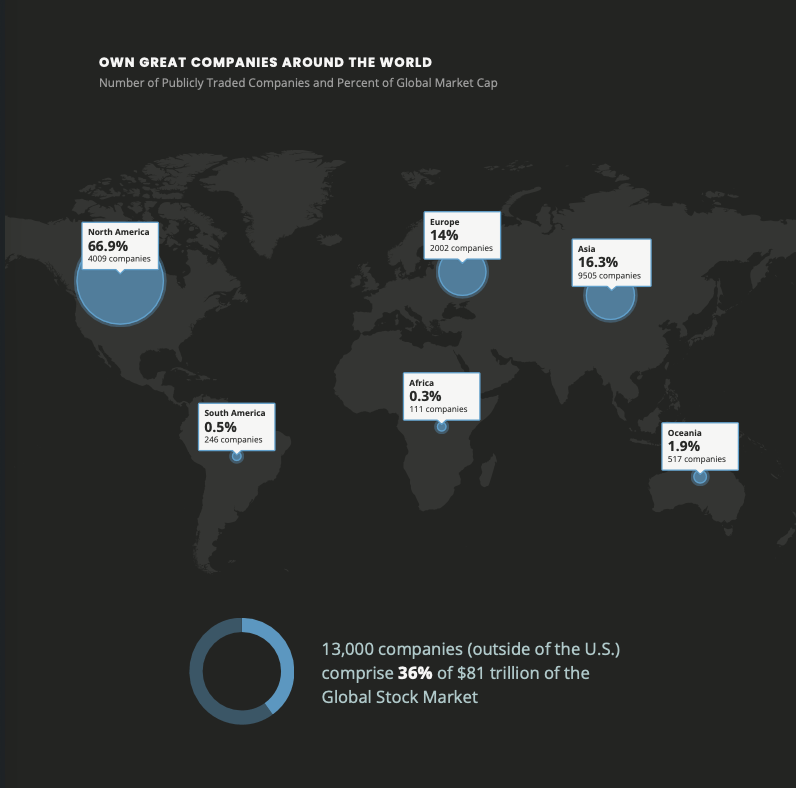
While the U.S. boasts the largest stock market, overlooking other global markets may present missed opportunity. The graphic shows that 13,000 companies outside of the U.S. comprise 36% of the Global Stock Market. That’s a world of opportunity beyond those large companies in the S&P 500. And it’s hard to predict which types of stocks will have the best returns, especially over the next year.